
Plenty has been written about what increases the value of a business.
Recurring revenue, systems, a repeatable way of winning customers. I've covered that in my guide on how to sell your business.
This is the other list. The discounts that can pull the price down between the LOI and closing.
No one wants to retrade on a promise, but when the facts change, so does what makes sense for both buyer and seller.
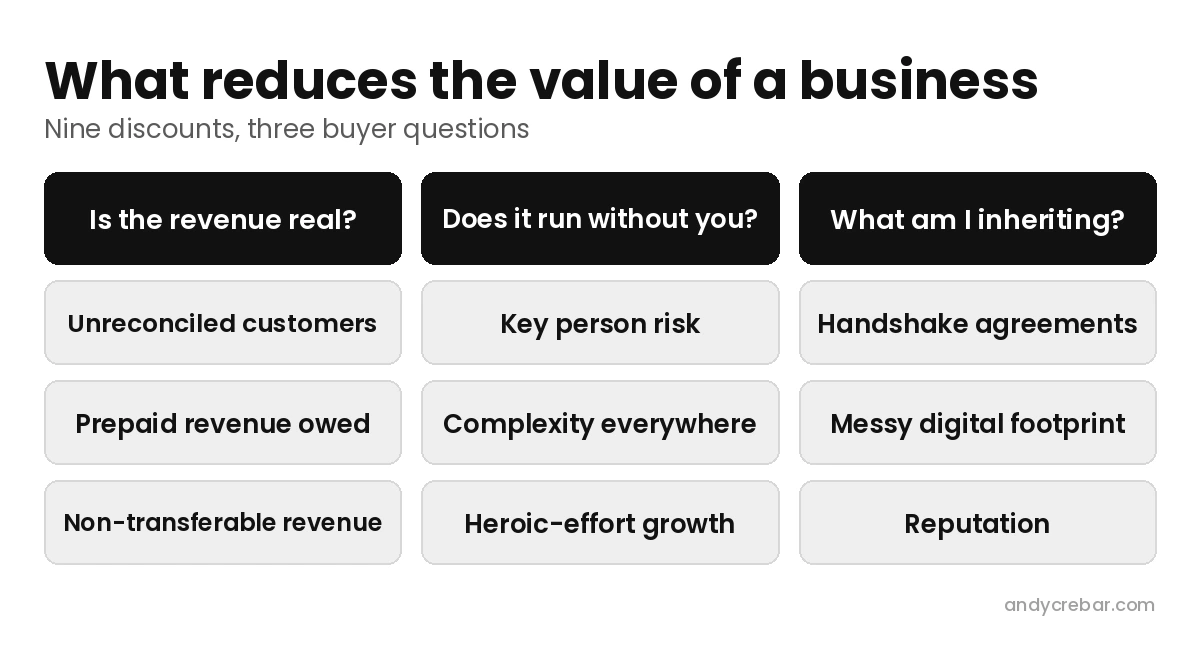
Reductions in value come back to three questions a buyer is asking.
Is the revenue as real as we thought?
Does the business really run without you?
What problems am I inheriting?
Question 1: Is the revenue real?
How much is a customer list worth?
Less than the number on it.
One business we bought came with what we thought were 100 customers.
But when we looked at who was actually paying, only 72 were on monthly billing. The rest were not healthy or had different billing set-ups. This changes what that revenue is worth (more on that next).
A customer only counts at full value if they're healthy, at arm's length, and paying.
So a list of 250 paying customers gets worked through like this.
Take out the paused accounts. Take out the ones yet to go live. Take out the related parties, like the website you host for your uncle, because that revenue doesn't transfer.
Adjust for the ones below market rate, and the ones on a handshake with no signed agreement. Then take out known churn, the unhappy ones who are one email away from leaving.
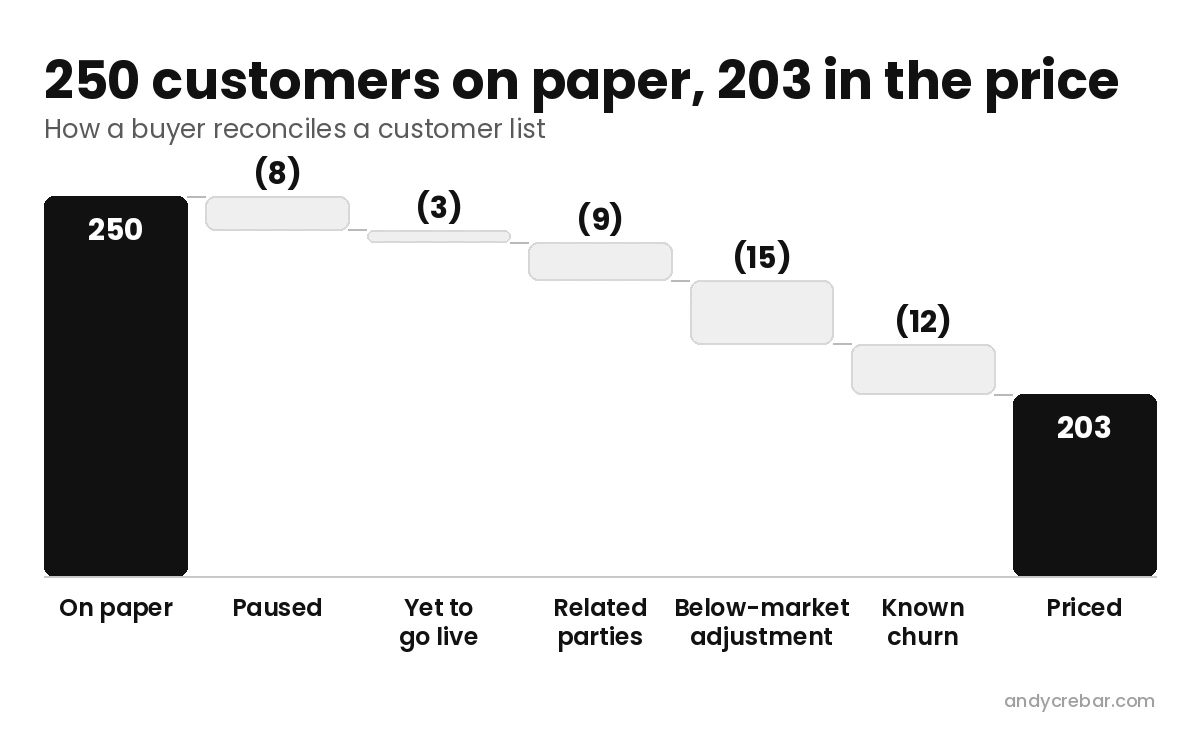
You and the buyer started at 250. After the shake-out, there are really only 203.
That's nearly 20% of the recurring value missing before anyone's negotiated anything. (Here's how agencies are valued if you want the full picture.)
This is the part that costs deal confidence the most. When the reconciliation happens during diligence, the buyer has to go back and adjust the price or terms everyone had agreed. It's the hardest conversation by far. Nobody likes walking back their word, and it sours the relationship on both sides.
New information in diligence always costs the seller more than the same information declared upfront.
Be really clear about where every customer stands before diligence starts.
Declare anything that could discount the valuation early. You'll protect the relationship, and probably the price. (More on this in negotiating the sale of your company.)
Prepaid revenue you still have to deliver
If you take annual upfront payments, that money isn't all yours at the sale.
You can't bank $10,000 of prepaid revenue, sell the business tomorrow, and expect the buyer to deliver a year of work for free.
That unearned revenue comes out of the price. It's one of the adjustments I covered in working capital adjustments, and it surprises almost every first-time seller.
Revenue that can't transfer
Revenue is only worth what the buyer can keep.
We used to run a white-label business. We exited it, and we don't do that work anymore. So when we look at an agency with white-label revenue, $1 million of revenue might only be worth $800,000 to us, because part of it is work we'd walk away from.
That's not the seller's fault. But every buyer prices revenue through the lens of what they'll actually keep. Deal structure matters here too: contracts and consents behave differently in an asset sale vs a share sale.
Question 2: Does the business run without you?
Key person risk
This shows up in two places.
The first is customer-facing. Everyone loves Sally. She signed the customers, holds the relationships, and knows how every account works. The buyer isn't just buying your business. They're betting on Sally staying.
The second is technical. The one developer who knows where the bodies are buried, especially in development operations. If one person holds the keys to how everything deploys and runs, that's a discount.
The fix isn't replacing these people. It's documenting what they know and spreading the relationships before you sell. (If the key person is you, read can you sell an owner-dependent business.)
Complexity everywhere
Different server setups. Passwords in five places. Two billing engines, with some invoices here and some there.
One business we bought served several bigger accounts, each with its own custom arrangement and way of working. Getting them aligned into one repeatable system took months. Ideally, you're serving the same type of customer, the same way.
No one will ever match the context and know-how of the founder or business owner. Your systems have to make sure they don't need to.
Growth that depends on heroic effort
Most agencies grow on word of mouth, referrals, and the founder's hustle. That's great, but it isn't repeatable and it doesn't scale.
A business with an inbound engine, an outbound motion or a paid system that wins customers without heroic effort is worth meaningfully more.
Your presence across the internet counts here too. Content, videos, and even those "Designed by" links in website footers drive real referral work. A business with none of that starts the new owner at zero.
Question 3: What is the buyer inheriting?
Handshake agreements
One business we bought had customers using five hours of support a month on plans that included one. Nobody had ever mentioned it, let alone invoiced it.
When we started sending polite reminders, the response was fair enough: it had never worked that way before.
That's a customer expectations problem. If the relationship runs on a handshake or an old proposal, expectations are unclear on both sides, and the buyer inherits every one of those conversations.
A messy digital footprint
Every asset you've built online is something the new owner takes on.
Is the brand ready to compete? Is the website current? Do the forms and workflows work? Instagram pages that are no longer maintained. Facebook pages that aren't linked up. A Google Business Profile that nobody has access to anymore. All of it becomes the buyer's cleanup job.
One business we bought had an Instagram account that looked terrible. We deleted it within weeks.
A bad Instagram account is worse than no Instagram account.
A big, spread-out footprint that needs polishing is a liability, because polishing it becomes the buyer's job. Clean house before anyone's looking.
Reputation
One business we bought had a great reputation. Calling past customers was easy, and every call built our confidence in the deal.
Another had a tougher reputation than we expected. It showed up in the details: unanswered support requests, old phone numbers that were never ported across, customers with a bad past experience they hadn't forgotten. Those reference calls were hard, and hard calls make cautious buyers.
You can't fix reputation in a due diligence window. You fix it years earlier, one customer at a time. (Related: what happens to customers when you sell your agency.)
What to do before you sell
If I were preparing to sell in the next two years, I'd do five things:
Reconcile your customer list today: healthy, at arm's length, and paying. Not at the LOI.
Declare anything that could discount the valuation before diligence, not during it.
Put every customer on a clear, written, assignable agreement at market rates.
Document what your key people know, in customer-facing and technical roles alike.
Build one channel that wins customers without heroic effort.