
Most small agencies sell for somewhere between two and three times their earnings.
Not revenue. Earnings.
That's the short answer. Here's how I'd work out where yours sits.
The Numbers at a Glance
| Source | Earnings measure | Multiple | What it covers |
|---|---|---|---|
| BizBuySell | SDE / cash flow | 2.5x - 2.7x | Small businesses sold on BizBuySell |
| Choice Business Opportunities | SDE | 1.2x - 3.5x | Small businesses by size of SDE |
| Flippa | Profit / EBITDA | 1.7x - 2.4x | Digital businesses by deal size (H1 2025) |
| Acquire.com | Net income | 3.7x - 3.9x | SaaS businesses sold in 2025 |
All figures are in USD.
What Actually Drives Value
In theory, a business is worth the cash it will make in the future, discounted back to today.
In practice, that's hard to calculate. So most small business valuations use a multiple of earnings instead.
Revenue multiples get thrown around a lot. But they're really just a proxy.
They only make sense when the earnings profile isn't telling you much, like a business in a heavy investment phase with no profit yet.
And businesses are always changing. Sometimes they shrink.
That's not normally the goal. But it can make sense if you're improving margins, focusing on other avenues, or it's just the nature of the industry.
When revenue is shrinking, a revenue multiple makes little sense. You're effectively saying the business is worth less every year.
So the focus goes back to the underlying earnings.
SDE, Not EBITDA
You'll see EBITDA quoted a lot. But EBITDA really belongs to passive ownership, where the buyer pays a management team to run the business.
Most small agencies are bought by active owners. That's where seller's discretionary earnings (SDE) is far more relevant.
SDE is your profit before your own salary and owner perks, plus interest, tax, depreciation and amortisation. It's what the business makes for one full-time owner-operator.
We learned this the hard way.
We looked at a bigger business where the owner had put in a full-time operations leader. Which was great.
But he was still doing 10 hours a week on sales.
Because the business ran without him day to day, he wanted it valued on EBITDA, with a salary added for someone to cover those 10 hours of sales.
We had to have the tough conversation.
Our view was that the business still needed 10 hours a week of founder time. So the right number was SDE, not EBITDA.
It taught me a simple rule.
SDE is for active ownership. EBITDA is only relevant when you're completely hands off.
A simple example. Say your agency shows $200k in profit after paying you a $150k salary. Your SDE is $350k. At 2-3x, that's $700k to $1.05M.
You can search far and wide and get ChatGPT to help you, but you'll find small businesses normally trade somewhere between 2 and 3 times SDE.
What the Market Data Says
Here's what four different marketplaces are showing. All figures are in USD.
One caveat. They don't all measure earnings the same way. BizBuySell and Choice use SDE, Flippa uses profit/EBITDA and Acquire.com uses net income. Treat the numbers as directional, not directly comparable.
1. The average business sells for about 2.7x earnings
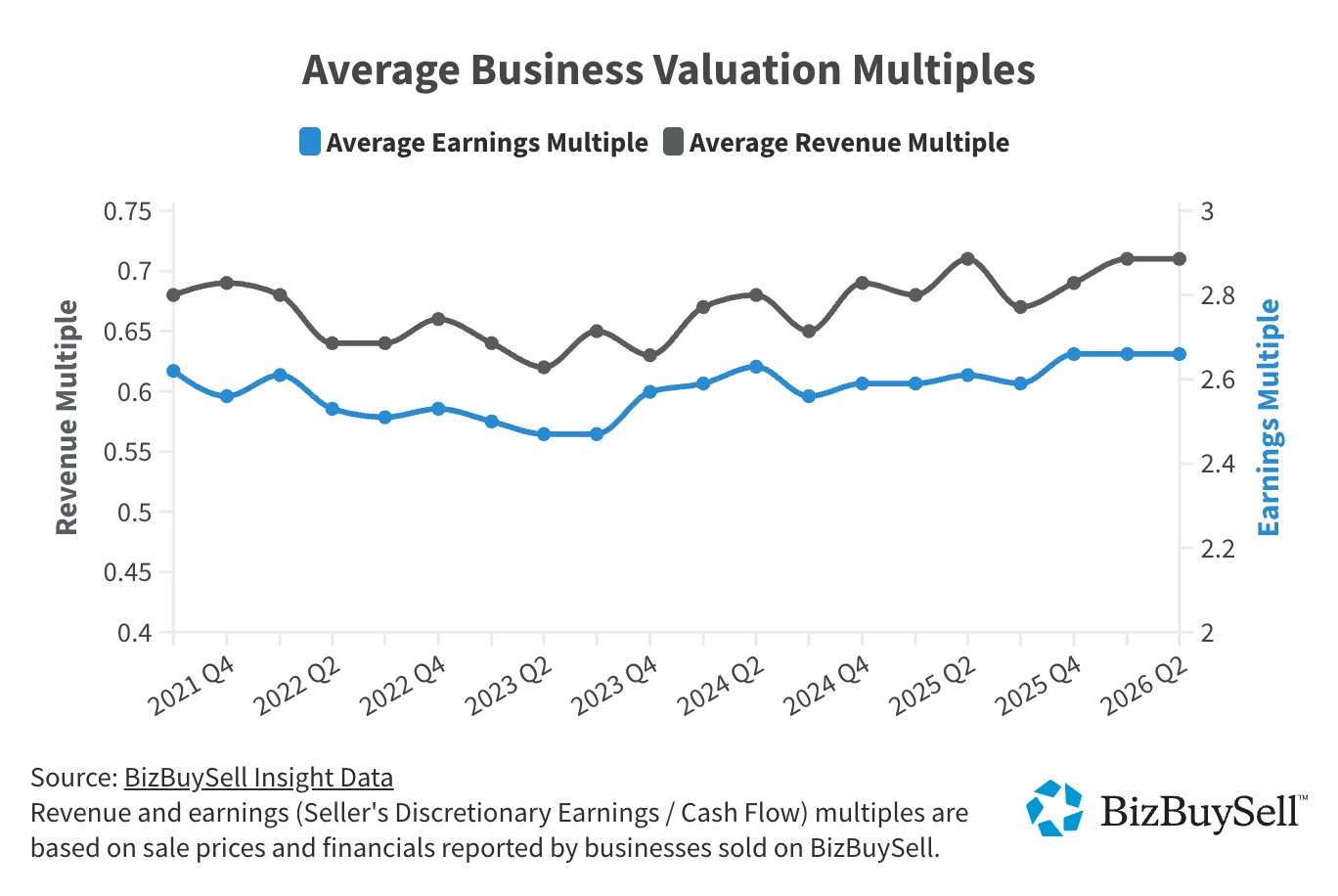
BizBuySell tracks the businesses sold through its marketplace. The average earnings multiple has sat between roughly 2.5x and 2.7x since 2021, landing around 2.66x in 2026 Q2. The average revenue multiple is around 0.7x.
2. Bigger earnings get bigger multiples
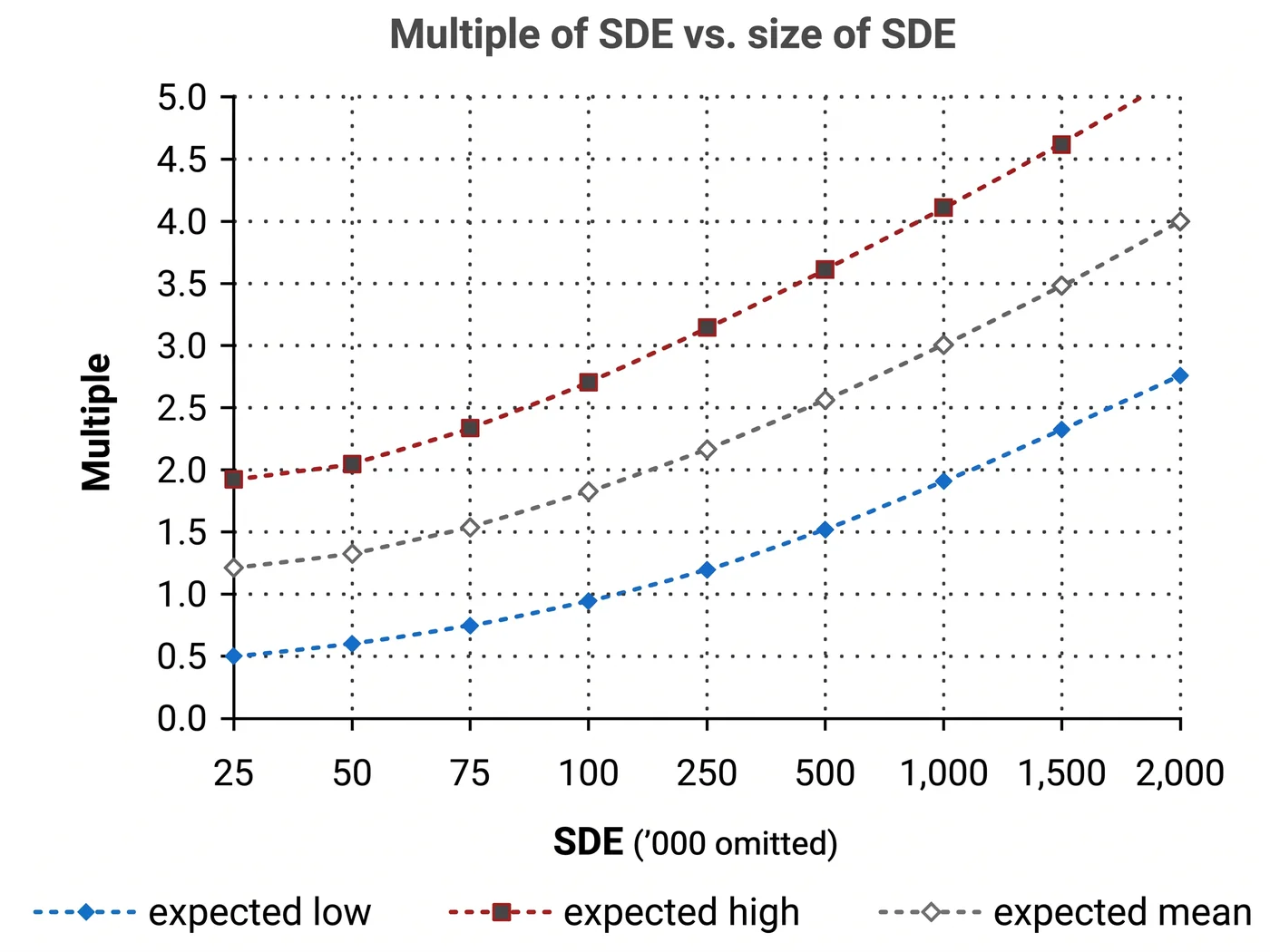
Size matters. A business with SDE under $100k typically sells for 1.2x to 2.4x. Over $100k, the range moves to 2x to 3x. Once SDE reaches around $500k, it extends to 2.5x to 3.5x or more.
3. Online businesses follow the same pattern
Flippa sees the same thing across digital businesses. Median profit multiples step up with deal size:
| Deal size | Median profit/EBITDA multiple |
|---|---|
| $10K-$100K | 1.68x |
| $100K-$500K | 1.96x |
| $500K-$1M | 2.18x |
| $1M+ | 2.43x |
Source: Flippa Data Insights, H1 2025 marketplace trends.
Bigger deals tend to have stronger systems, less key-person risk and more buyers competing for them.
4. Software sets the ceiling
Acquire.com focuses on SaaS. Across 136 reported deals in 2025, confirmed purchase prices came in at 3.7x net income for businesses under $100k and 3.9x for $100k to $1M. Median time on market was 90 days.
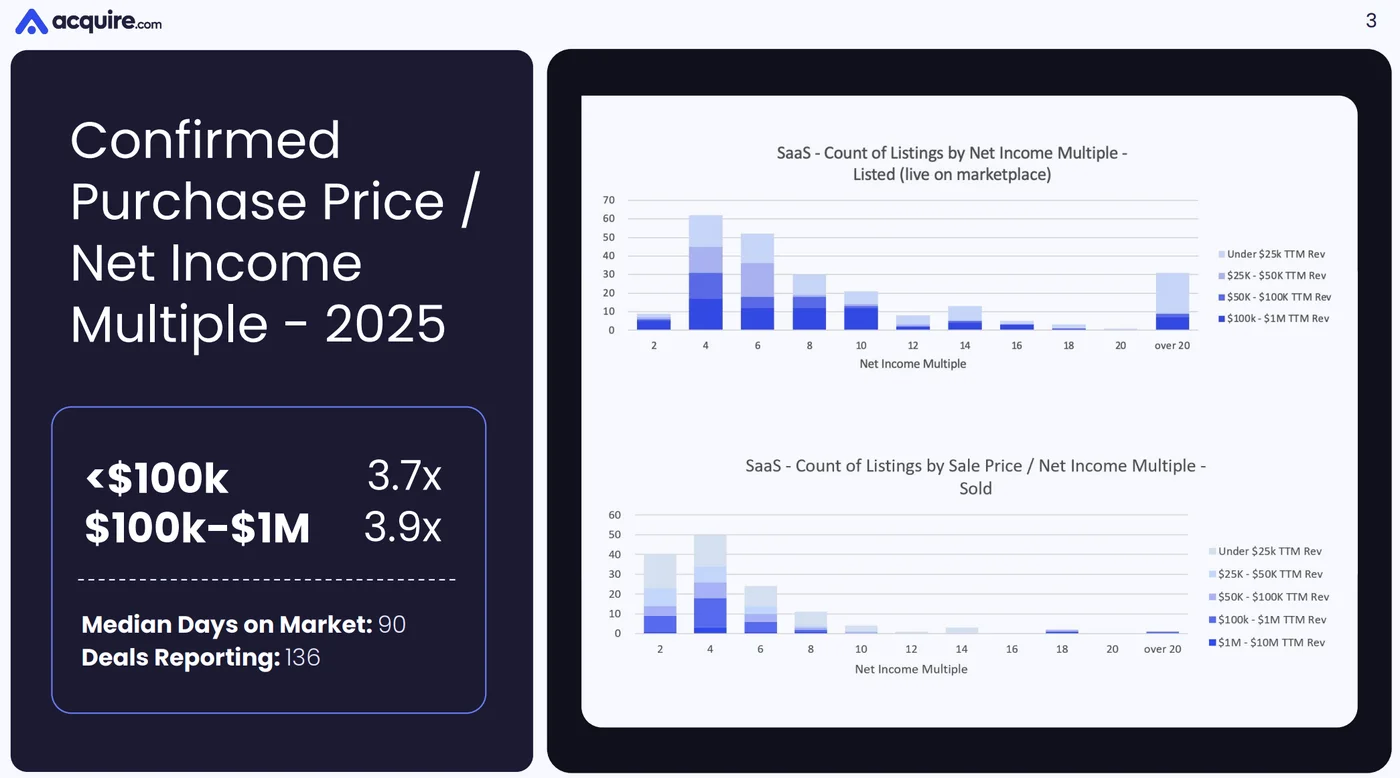
Think of this as the upper bound. Agencies without software-like recurring revenue trade lower.
Most agencies land at 2-3x SDE. Size pushes you up. Software-like recurring revenue pushes you towards the ceiling.
Where You Land in the Range
The data gives you a range. These five things decide where in it you sit.
1. Where's the Money Coming From?
How much of your revenue is one-off project work, and how much is recurring hosting, maintenance, support and SEO?
The more predictable your future revenue, the better.
A solid base of recurring revenue means a buyer has a steady stream of income from day one. That's a lot less risky than a business always chasing the next big project.
2. How Strong Are Your Relationships?
Your business is your clients.
If they're all going to walk out the door the day you leave, it's hard for a buyer to get confident.
You want clients who are loyal to the brand, not just to you. That means a team that can build and maintain those relationships.
3. Does Your Brand Have Gravity?
A strong brand is a massive asset. It's an engine that drives new business, and something a buyer can build on.
I meet a lot of founders who think they've got a great brand, but their website gets no traffic.
It's not a brand if it doesn't have its own momentum.
Size matters here too. A brand known for larger, more sophisticated projects is worth more than one known only for small, simple websites.
4. Is It a One-Person Show?
You know the story. The founder is the business.
They're the lead salesperson, the lead developer, the chief firefighter.
That's a huge risk for a buyer. What happens when the founder leaves?
The less your business depends on any one person, the more it's worth.
5. Simple Is Scalable
The more complicated your business, the harder it is to grow. And the harder it is to value.
A tonne of custom work for each client drags your valuation down. If it's hard for a buyer to understand, it's hard for them to scale.
One system, one billing engine, one process a buyer can quickly plug into is far more attractive.
Most buyers want growth, and simple is always easier to scale than complex.
The Hardest Conversation
Valuation is one of the hardest conversations in any deal.
If an owner thinks you're giving them a low number, they hear that you're disrespecting the business they built.
That can break a deal. It can also start the relationship off on the wrong foot.
It's one reason deals that come through a broker are often far more likely to reach the finish line. The broker has already had the hard chat and set expectations.
If you're selling direct, nobody's had that chat for you. So have it with yourself first.
Pitfalls to Avoid
Agency owners make three familiar mistakes when it comes to valuation.
- Overvaluation. We all love our own businesses, but you have to be realistic. Don't let emotional attachment cloud your judgment.
- Underestimating transition costs. Server setups, team training, client handovers. It all adds up, and buyers factor it in.
- Founder dependency. The less your business depends on you, the more it's worth.
Where to Start
Valuing any business is subjective. The best benchmark is the range similar businesses have actually traded for.
For most small agencies, that's 2-3x SDE.
If you want to be at the top of the range, show strong recurring revenue, loyal clients, a brand with momentum, a team that runs without you, and simple, scalable systems.
Once you know your number, the next step is getting it. That's where negotiating the sale comes in, and it's worth knowing what the process feels like before you start.
Frequently Asked Questions
How do I calculate SDE?
Start with your profit. Add back your own salary and owner perks, plus interest, tax, depreciation and amortisation. That's what the business makes for one full-time owner-operator.
What multiple do agencies sell for?
Most small agencies trade at 2-3x SDE. Bigger earnings push the multiple up. Software-like recurring revenue pushes it towards the ceiling, which is around 4x for SaaS.
Is EBITDA the same as SDE?
No. EBITDA assumes a paid manager runs the business, which suits passive ownership. SDE includes the owner's salary, so it's the better measure when the buyer will run the business themselves.
Should I use a revenue multiple?
Only as a proxy, when earnings aren't telling you much, like during a heavy investment phase with no profit yet. If revenue is shrinking, a revenue multiple makes little sense, so focus on earnings.