
What happens to employees when a company is sold?
When I sold my first company, that was the most nerve-wracking question of the whole deal.
What will the team think? Will they stay? Will they go?
And if they go, how do I explain that to the buyer?
It matters because the team is the business. In an agency, that's even more true.
I've sold four companies. Two of them had real teams, from 10 to 60 people. Both took a huge amount of prep: planning the messaging, practising it, executing on the day, and the follow-up conversations after.
Since 2024 I've been buying and growing web and digital agencies. So I've now seen this from both sides of the table.
Here's what I've learnt about getting a team through a sale, and the simple framework I use for every person. It's one part of the bigger process in my guide to selling your business.
Why teams go sideways after a sale
I've seen this go badly when the team isn't included in the conversation, or isn't given a reason to care about what comes next.
They get frustrated and the buyer inherits bad blood they didn't create.
Most of it comes back to two things: money and career uncertainty.
Start with the money
People need their pay for rent and living.
So before you talk about the future, make sure everyone knows exactly where they stand on what they're owed.
One business we bought had a handful of people who were behind on their salaries. It added up to thousands of dollars.
I get why it happened. The closing-day working capital numbers were still moving.
But that's no comfort when your rent is due.
We ensured they were paid.
You can't ask people to trust the next chapter while the last one still owes them money.
In another deal, it went the other way.
One of the contractors kept working as usual after closing day. A week later, he charged us for that week.
We'd never instructed the work. He thought things would just carry on the same.
Nobody had told him otherwise. That was our problem.
We paid him for his time and made it right. But the lesson stuck.
In a handover, don't assume anything carries over. Confirm everything.
Both of these were avoidable. You have to communicate this stuff ahead of time:
Who pays what's owed up to closing day? (That's a working capital adjustment question. Get it in the documents.)
Whose agreement moves across to the new owner, and when? (In an asset sale, every agreement has to change over. More in asset sale vs share sale.)
Who is still instructed to work after closing, and who isn't?
The framework: two questions for every person
Once the money is clear, you can talk about the future.
This is the simple framework I use. For every person in the business, ask two questions:
Is this role needed in the future?
How has this person performed historically?
That gives you four boxes, and each box has a different answer.
This is how I look at a team as a buyer. If you're selling, run it yourself first, so nothing surprises you or your people.
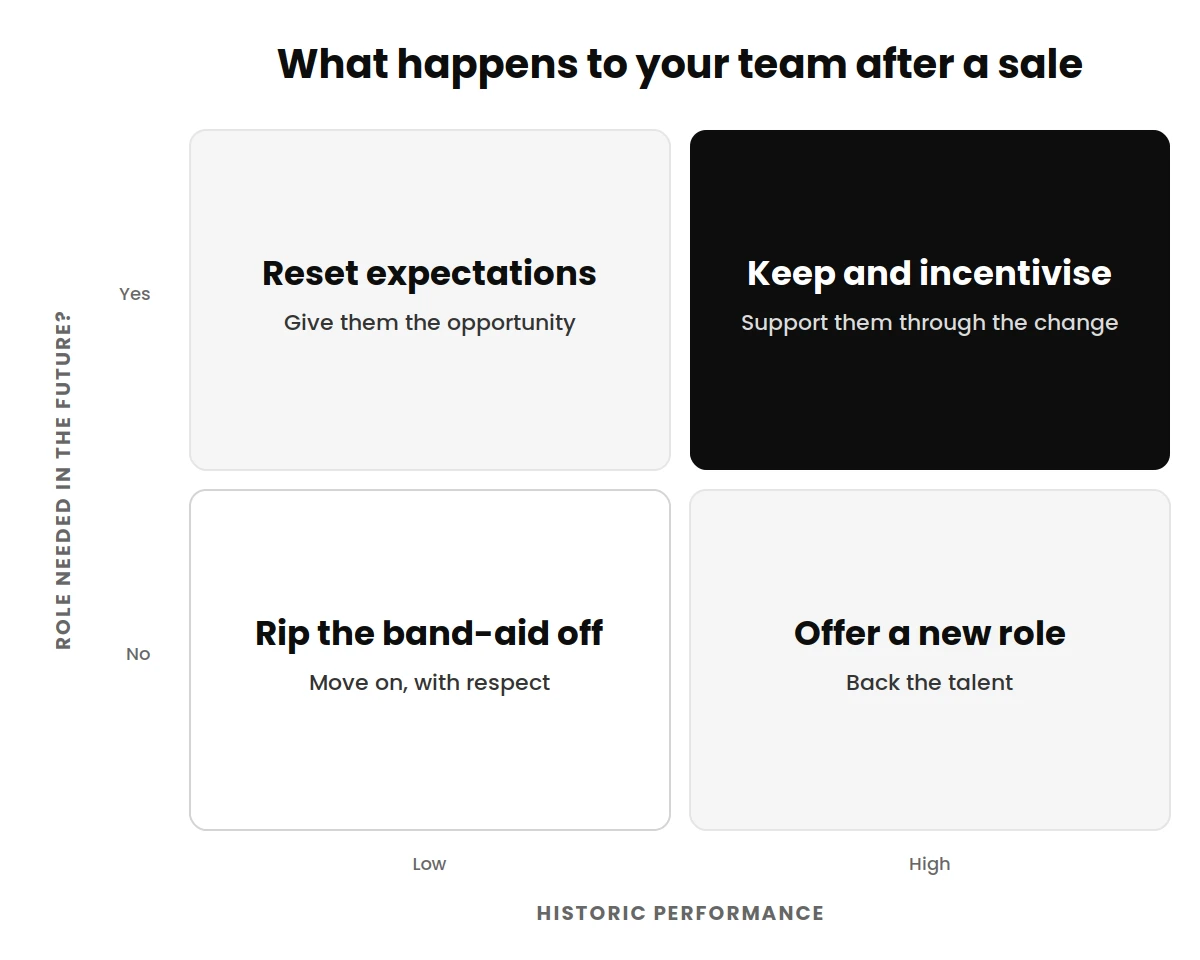
It sounds obvious written down. But each box plays out very differently, so here's what they've looked like for me.
Role needed, top performer: keep and incentivise
One of the businesses we bought had a key leader who'd been there for many years.
Keeping him was a no-brainer. The question was how.
The answer was a long-term incentive program. It focuses him not on the next pay cheque, but on the next few years of the business and how to grow its value.
Your best people have the most options. You need to give them a reason to think in years, not weeks.
Role needed, not performing: reset expectations
In another business, the owner had been keeping someone on for continuity.
They weren't performing. And they didn't have the energy for the change a sale brings.
We gave them the opportunity anyway. Clear expectations, a fair go.
It didn't work out. They were out of the business within six weeks.
I don't regret giving them the chance. People deserve one, but I've learnt not to drag it out once the answer is clear.
Role not needed, top performer: offer a new role
Sometimes the role isn't needed anymore, but the person is exceptional.
That's when you find them a new seat. But it has to line up with two things: their skill set, and where they want to go.
One project manager on the team had been focused on small web projects.
We encouraged and supported them to take on more strategic projects and manage a team.
They grew a tonne. It was so great to see.
A role can become redundant. Talent doesn't.
Role not needed, not performing: rip the band-aid off
There have been many times where the role wasn't needed and the track record wasn't great.
What I've learnt is you're better off moving them out straight away (or before closing) than trying to make it work.
It can be really tough because you want to be delivering good news to everybody, but there's also bad news for some people. That's why it's better done separately from the announcement (ideally a few weeks before).
If you don't, the buyer inherits the issues that came with the role, and you plant those seeds in the next chapter of the business.
But these are people with families and responsibilities. Treat them with complete respect.
Ripping the band-aid off doesn't mean leaving someone stranded. It means they're taken care of:
They're paid everything they're owed.
Their severance is paid.
They get a supportive reference, where it's relevant.
They get a reasonable payout on top, whether that's a few days or a few weeks, depending on their role.
Expect turbulence
A sale is a natural point in anyone's career to stop and reassess.
Am I doing what I want to be doing? Is this still the place for me?
So expect some turbulence and some people will leave, which is okay.
Because you'll also see people step up into huge roles and do exceptionally well. I've seen it over and over again.
The way to tip the balance is to keep people focused on the long term. Long-term incentive programs, bonus structures, career development. All of it should be discussed with the buyer.
It's ultimately their decision as they're the ones running the business next.
But if you know where each person is at, you'll bring a lot more empathy to that conversation, and help the buyer make better calls for your team. (For the buyer's side after close, see the first 100 days of an acquisition.)
Before you sell: three things to do
Put every person in a box. Run the two questions across your whole team before a buyer asks.
Get clear on the money. Who pays what's owed to closing day, whose agreement changes over, and who is (and isn't) instructed to keep working after close.
Tell each person where they stand. Whether they have a role or not, be extremely clear about what's expected next. Have the hard conversations separately, ideally a few weeks before any announcement.