
15 years ago, I was a graduate in investment banking, working on a billion-dollar deal.
I wanted to succeed and when there's a live deal on, the team is in crunch mode.
Late nights and early mornings like you hear about in the clichés.
One evening, I went home early. I was tired and wanted to watch Game of Thrones with my girlfriend.
And that night, the deal hit a milestone. The team was there for it. I wasn't.
The next morning, I found out the deal was progressing to the next stage and new responsibilities had been given out. I asked my manager why I wasn't involved.
"Crebar, you decide your level of involvement. If you want in, you need to be here."
He was right. If I'd been there, I'd have been part of it.
Over the next few days, it kept rattling around in my head.
He wasn't talking about one night. He was talking about my whole career.
Ambition is not ownership
I'd been waiting for someone to notice I was keen and to be brought into the interesting work.
Nobody was coming to do that.
If I wanted to get ahead, I had to:
Be all over my current responsibilities
Jump on every opportunity to grow
Be ready for more before more showed up
At that point in my career, I had plenty of ambition. What I didn't have was ownership.
Those are two different things. Ambition is how much you want more. Ownership is how well you handle what you already have.
Put them together and you get four types of people:
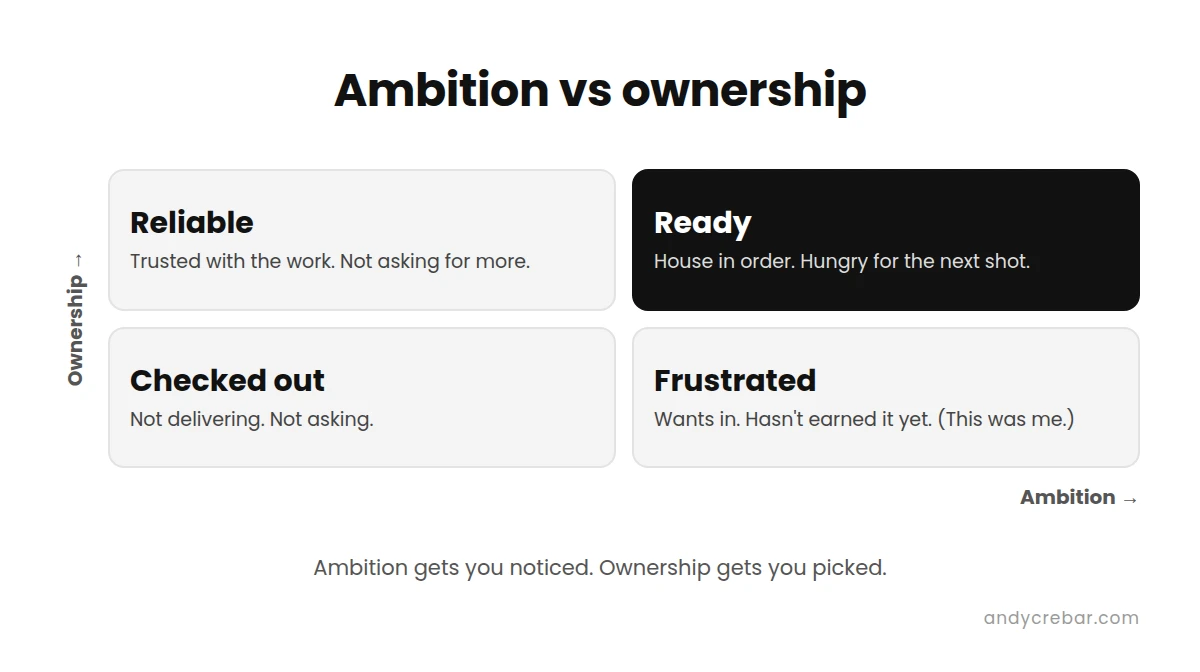
Checked out is low on both. Reliable owns the work but isn't pushing for more. Ready has both, and gets the next shot.
Then there's frustrated: high ambition, low ownership. That was me. I could see the opportunity. I couldn't work out why nobody was handing it to me.
Ambition gets you noticed. Ownership gets you picked.
The 7am email
A few months later, a role opened up on the equities desk.
They needed someone to write the morning email. Pull together everything that happened in markets overnight and send it to the desk before the open.
At that point in my life, I thought I wanted to move to the trading floor. I'd been trading stocks since uni (I wrote about that in 3 Simple Rules to Multiply Your Money).
The catch was the hours.
I was already working late nights and this would mean being on the equities floor at 7am, every morning, to get it out by 7:30.
I said yes on the spot.
So there I was. Late nights upstairs on the deal team. Then 7am on the equities floor, coffee in hand, writing up what the markets did overnight.
It was exactly the exposure I wanted in my career and I only got it because I decided my level of involvement.
I thought I'd figured something out. Turns out I'd just found it for myself.
It's an old idea:
Trusted with little, trusted with much.
Most lessons that matter work like this.
You don't learn them from a book. You learn them from a moment that stings. Then years later you read something old and think, oh yeah. Someone knew this all along.
Now I'm the one saying it
Fifteen years later, I have this conversation regularly.
People want a bigger role in the team, but they're not ready for it yet.
I get it. I had that turning point in my career.
But pulling someone into the next thing before their current work is in order doesn't help them. It overwhelms them, and sets them up to fail in front of more people.
Is their current work handled without me chasing it? Do they show up when it matters, without being asked? When they miss out, do they ask how they can help, or why they weren't included?
When I see those things, I don't need to be convinced. The next opportunity finds them.
What to do on Monday
If you want more involvement, start here:
Fix the thing you get chased on. If someone is asking you for an update, your workflow is broken.
Find the next crunch and clear your calendar for it. Know when the big deadline, launch or deal is coming before anyone asks.
Volunteer for the job nobody wants. Mine was a 7am email.
Constantly ask "what else can I take off your plate?" Then do it.
The opportunities that grow your career rarely arrive at a good time. They arrive on top of everything else.
Nobody is coming to pull you up. You decide your level of involvement.